
Increasing Facebook engagement in 2026 is not a matter of finding one algorithm trick. For publishers, it means producing original posts that deserve a reaction, comment, share, click, or sustained view, then learning which editorial choices repeatedly work for a specific audience.
The shortest useful answer is this: publish original reporting in a format made for Facebook, give the audience a precise reason to care, and measure every format separately. Meta says its recent ranking improvements increased views of organic Feed and video posts, while its current recommendation rules explicitly favor useful original work over low-value republishing.
This guide turns those principles into a newsroom process. It combines Meta's current guidance, public Facebook insights, and patterns visible in Nonli's 2026 media rankings.
1. The 2026 Facebook engagement playbook#
If your team needs a plan before the next editorial meeting, start here:
- Define the outcome before publishing. Decide whether a post should create discussion, earn shares, drive qualified clicks, or hold attention on video.
- Create a Facebook-native treatment. Do not paste the same headline and asset used everywhere else.
- Make the editorial value obvious immediately. Lead with the consequence, new fact, tension, or service information.
- Use original visuals and reporting. Add the newsroom's footage, data, analysis, quote, map, or explanatory framing.
- Invite a real response, not empty engagement. Ask for experience, evidence, or a choice the audience can genuinely discuss.
- Test one variable at a time. Change the hook, format, timing, or first-comment treatment—not all four together.
- Review weekly and reuse patterns, not posts. Preserve the editorial structure that worked while keeping each story original.
2. What Facebook engagement actually measures#
The word engagement becomes unhelpful when every interaction is combined into one total. Facebook Page insights expose post reach and engagement, and Meta Business Suite provides post-level reporting. For a publisher, the useful scorecard separates at least five behaviors:
| Signal | What it can tell a newsroom | What it cannot prove alone |
|---|---|---|
| Reactions | The post created an immediate response | That the article was read |
| Comments | The subject opened a conversation | That every comment was positive or useful |
| Shares | Someone considered the post worth redistributing | That the shared audience clicked |
| Link clicks | The social promise moved people toward the article | That they stayed or subscribed |
| Video views and watch behavior | The visual treatment held attention | That viewers understood or trusted the story |
Facebook's own help documentation recommends using Page and Meta Business Suite insights to compare reach and post engagement. Nonli keeps these signals usable across accounts: our definition of Facebook engagements groups reactions, comments, and shares while leaving clicks and other consumption metrics visible separately.
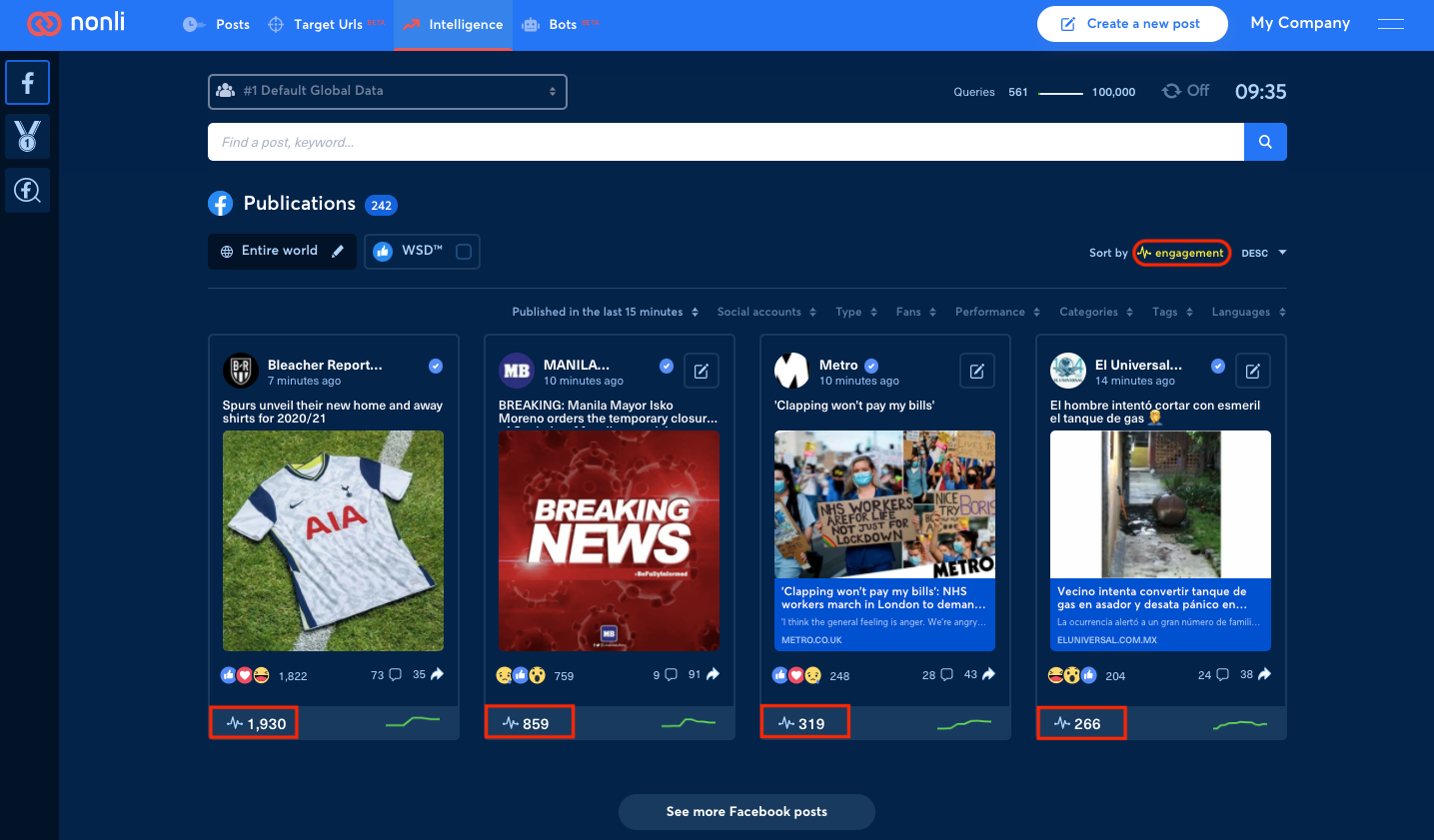
The separation matters. A breaking-news clip can win on views, a service post can win on shares, and an investigation can win on qualified clicks. Calling only one of them “engaging” would hide what the audience actually did.
3. Diagnose the problem before changing the content#
Compare the last 28 days with the previous 28 days, but do not stop at the Page total. Build a table by format, desk, topic, time slot, and intended outcome.
For each post, record:
- format: link, image, carousel, native video, Reel, Live, or text;
- editorial desk or topic;
- original asset versus republished asset;
- hook pattern;
- publication time;
- reach, reactions, comments, shares, clicks, and video results;
- outcome after the click when analytics permits it.
Then look for a bottleneck:
- Low reach with solid interaction among reached users suggests a distribution, eligibility, or audience-fit problem.
- Good reach with weak interaction suggests the treatment was visible but not compelling enough.
- Strong social interaction with weak clicks suggests the post worked as a Facebook object but the article promise or link treatment did not.
- Strong clicks with quick exits suggests a mismatch between the social hook and the landing page.
Meta notes that organic reach changes with prior audience behavior, content quality, timing, device context, and how people engage with similar content. That is why a newsroom should diagnose by cohort instead of blaming a single opaque “algorithm.” See Meta's explanation of organic and paid reach.
4. Turn original reporting into original social content#
Meta's clearest 2026 direction is originality. In March, the company said it was prioritizing original content in Feed and Reels and reducing distribution for duplicative or minimally edited material. Meta also says recommendation eligibility can be limited for unoriginal publishing that adds no material value.
For a publisher, original social content does not require a second reporting project. It requires a distinct treatment of the reporting you already own:
- cut the reporter's strongest explanation into a short vertical video;
- turn three verified numbers into a simple chart;
- use an original quote with enough context to stand alone;
- show the document, map, timeline, or field footage behind the article;
- let the journalist explain what surprised them and what remains unknown.
The source is the newsroom's reporting. The added value is the social treatment. Meta's 2026 original-content guidance distinguishes meaningful new analysis or creative transformation from low-value reposting.
My take: publishers have an advantage that generic creators cannot easily copy: reporters, archives, access, local knowledge, and verified information. The engagement strategy should make that advantage visible instead of disguising journalism as a generic viral post.
5. Build hooks around consequences, not curiosity alone#
A useful Facebook hook answers one of these questions immediately:
- What changed?
- Who is affected?
- Why does it matter now?
- What will the audience understand after clicking or watching?
Compare two treatments:
You won't believe what the council voted last night.
The council approved a 12% parking increase. Here are the neighborhoods affected from September.
The first creates a curiosity gap but gives the audience no reason to trust the payoff. The second names the consequence, the scale, and the service value. It can still create discussion, but the discussion begins with information.
Avoid asking for reactions that have no editorial meaning. Facebook's recommendation rules identify coordinated or artificial engagement patterns and low-quality publishing as risks. A precise question is better: “Which route will this closure change for you?” is useful; “Comment YES if you agree” is not.
6. Treat video and Reels as reporting formats#
Meta reported in January 2026 that Facebook's Q4 2025 ranking improvements produced a 7% lift in views of organic Feed and video posts, with US video time growing by double digits year over year. It also said Facebook was surfacing more same-day Reels. Those are platform-wide figures, not a guarantee for any Page, but they justify giving video a disciplined place in the mix. See Meta's 2026 performance update.
For newsrooms, the strongest video tests are usually repeatable editorial formats:
- a reporter explains one development in 30–60 seconds;
- a before/after sequence makes a local change visible;
- a three-point service update answers the public's immediate questions;
- original field footage is edited around one clear narrative;
- a data story becomes a chart-led vertical explainer.
Do not judge these formats only by total views. Compare reach beyond followers, retention, shares, comments, and the next action. A short clip that reaches widely but creates no durable audience may serve a different goal from an explainer that reaches fewer people and earns qualified visits.
7. Stop searching for a universal posting frequency#
Nonli's June 2026 Facebook rankings show why generic frequency advice fails publishers.
Among French national news Pages, BFMTV led with 376.9 million video views from 474 posts, while HugoDécrypte reached 21.9 million views from 92 posts and recorded the table's strongest views-per-follower ratio at 73.5%. In the regional-press ranking, Ouest-France generated 25 million views from 88 posts, while Dernières Nouvelles d'Alsace generated 26.5 million from 348.
These figures measure video distribution, not a universal engagement rate. They still make one point clearly: high output and lower output can both work when the content, audience, and editorial model differ.
Use the June 2026 national media ranking and regional press ranking as reference data, then establish your own baseline. Increase cadence only when the next post adds editorial value and does not reduce the performance of the surrounding posts.
8. Design comments as an editorial space#
Comments are not merely a number under the post. They can surface questions, corrections, local testimony, and follow-up angles. Assign ownership for the first hour on priority posts:
- answer factual questions with a source;
- correct misunderstandings without becoming defensive;
- ask a useful follow-up when someone contributes experience;
- capture recurring questions for a follow-up article or explainer;
- moderate abuse consistently so useful contributors are not driven away.
For link posts, test whether the article URL belongs in the main post or in a first comment. Do not assume one placement always wins. Nonli can publish and track an automatic first comment, which makes the treatment repeatable across the team.
9. Make the workflow testable across the newsroom#
One successful post is an anecdote. A tagged series of posts is evidence.
Create a small test vocabulary in the editorial calendar:
hook: consequence,hook: question, orhook: quote;format: reporter-video,format: chart, orformat: link-card;goal: discussion,goal: share,goal: click, orgoal: watch;treatment: main-linkortreatment: first-comment.

Change one major variable per test and compare at least several posts across more than one news cycle. Nonli's publishing workflow helps teams prepare the post, adapt the message for each account, and keep measurement connected to the published item. This post-creation view shows the shared workflow used to prepare a publication.
10. A 30-day plan for improving Facebook engagement#
10.1. Week 1: establish the baseline#
- Export or record 28 days of post-level results.
- Separate formats and editorial desks.
- Identify three strong posts and three weak posts for each important format.
- Write down the intended outcome of each selected post.
10.2. Week 2: test hooks and original treatments#
- Choose two repeatable story types.
- Produce one original visual or video treatment for each.
- Test two hook patterns while keeping timing and format comparable.
- Assign comment ownership on the priority posts.
10.3. Week 3: test distribution choices#
- Compare the best-performing treatment in two time slots.
- Test main-post versus first-comment link placement where appropriate.
- Check recommendation eligibility and Page health before interpreting low reach.
- Record clicks and downstream quality separately from interactions.
10.4. Week 4: standardize what worked#
- Keep the two or three patterns that performed across several posts.
- Document them as editorial templates, not copy-and-paste formulas.
- Remove the tests that produced only vanity interactions.
- Set the next monthly hypothesis from observed audience behavior.
11. What results should a publisher expect?#
Within four weeks, a disciplined team should be able to identify stronger hooks, formats, and workflows. That does not mean every metric will rise at once. Reach, conversation, video attention, and referral traffic can move differently.
Measure progress against the right baseline:
- median result per format, not only the single best post;
- reach among followers and non-followers when available;
- reactions, comments, and shares per reached user;
- click-through rate for link-led posts;
- video retention and views per follower for video-led posts;
- qualified sessions or subscriptions after the click.
The goal is not to manufacture more interactions. It is to make more of the newsroom's work discoverable, discussable, and useful—and to know which editorial decisions caused the improvement.
12. Sources and methodology#
This guide was reviewed on August 10, 2026. Platform guidance and metrics can change, so verify the linked Meta documentation before turning any tactic into a permanent rule.
- Meta: Rewarding Original Creators on Facebook
- Meta: 2026: AI Drives Performance
- Facebook Help Center: About recommendations on Facebook
- Facebook Help Center: See insights for your Facebook Page posts
- Nonli: June 2026 Facebook ranking for French news media
- Nonli: June 2026 Facebook ranking for regional press
13. Frequently Asked Questions#
What counts as Facebook engagement for a publisher?
For a practical newsroom scorecard, track reactions, comments, shares, clicks, and video consumption separately. Nonli's Facebook engagement metric focuses on reactions, comments, and shares, while clicks and video views remain distinct so teams can tell conversation from traffic and attention.
How often should a publisher post on Facebook?
There is no universal winning frequency. Start from the cadence your newsroom can sustain with original, useful posts, then compare performance by format and time slot. Nonli's June 2026 media rankings show strong pages succeeding at very different cadences, so quality and audience fit matter more than a generic posts-per-day target.
How long does it take to improve Facebook engagement?
A publisher can usually identify useful format and hook patterns within four weeks if it tags tests consistently and reviews results every week. A durable improvement takes longer because the team must repeat the winning patterns across several news cycles without lowering editorial quality.
Do external links automatically reduce Facebook engagement?
Meta does not publish a rule saying that every external link is automatically penalized. Publishers should compare link posts with native formats, judge the promise and landing-page quality, and separate engagement, reach, and click-through results before changing their distribution strategy.